I was surprised at the recent burst of activity on my post back in April titled, Debunking the Spaulding Manuscript Theory. One of my commenters (Roger) seem to believe the Spaulding Theory still has merit. I even had Craig Criddle stop by. He is a leading proponent of the theory and published a peer-reviewed article at Oxford in support of this theory. (You need a subscription to read it, but the abstract can be found there.)
Roger took issue Brodie’s characterization that Spaulding’s manuscript was “devoid of religious material”, and made several references to religious writings in this comment. So, if Roger is right, it seems there should be quite a few religious similarities between this Spaulding manuscript, and the Book of Mormon, right?
As the theory goes, Joseph wasn’t smart enough to write the Book of Mormon by himself. Sidney Rigdon must have stolen a copy of Spaulding’s manuscript, secreted it away to Joseph Smith somehow, and then Sidney pretended to convert in Dec 1830. According to the theory, both Rigdon and Spaulding lived in Pittsburgh, PA, so Sidney must have come across the manuscript at a printer’s office.
Spaulding’s manuscript was discovered by Doctor Hurlburt (Doctor is his first name–he is not a “real” doctor) in the home of Spaulding’s widow, Matilda Davison, who gave the manuscript to Hurlburt. Spaulding died on Oct 20, 1816, so this document was written well before Joseph Smith’s First Vision in 1820. While there are some very general similarities, according to Brodie on page 144 of her book No Man Knows My History,
Now to his bitter chagrin he found that the long chase had been vain; for while the romance did concern the ancestors of the Indians, its resemblance to the Book of Mormon ended there. None of the names found in one could be identified in the other; the many battles which each described showed not the slightest similarity with those of the other, and Spaulding’s prose style, which aped the eighteenth-century British sentimental novelists, differed from the style of the Mormon Bible as much as Pamela, or Virtue Rewarded different from the New Testament.
LL Rice purchased the assets of the Painesville Telegraph in 1839-40. In 1885 or so, he looked through the assets and discovered Spaulding’s Manuscript. The manuscript was donated to Oberlin College after being discovered in Hawaii. You may view the manuscript here. Due to the obvious differences between the manuscript and the Book of Mormon, proponents of the theory have postulated that Spaulding must have another manuscript which is similar to the Book of Mormon. Proponents think that perhaps Smith and Rigdon burned the manuscript after completing the Book of Mormon.
So, after hearing Roger talk about how much religion was in the book, I decided that I must read it. I plan to review the introduction today, and in some future posts, I’ll outline the book, and offer my commentary on it.
Pages 3-11 tell how the document came into the hands of Oberlin College, and has letters to Joseph Smith III (Joseph’s son), who was ordained prophet of the RLDS church on April 6, 1860. Apparently the RLDS church published the manuscript sometime around 1885. Some interesting quotes from these pages start on page 5-6. The document was discovered in Hawaii by Rice who was a friend Fairchild, president of Oberlin College in Ohio. Many people wanted to claim the manuscript, but they felt it best to offer it to Joseph III, since he is the son of Joseph Smith. I have underlined some points I find interesting. Let me quote from pages 5-6,
“There seems to be no reason to doubt that this is the long-lost story. Mr. Rice, myself, and others, compared it with the Book of Mormon, and could detect no resemblence between the two, in general or in detail. There seems to be no name or incident common to the two. The solemn style of the Book of Mormon, in imitation of the English Scriptures, does not appear in the manuscript. The only resemblance is in the fact that both profess to set forth the history of the lost tribes. Some other explanation of the origin of the Book of Mormon must be found, if any explanation is required.”
Signed, James H. Fairchild.
From page 7 is another interesting difference between the Book of Mormon and this Oberlin College Manuscript. This is the second half of a letter written March 28, 1885 from LL Rice to Mr. Joseph Smith III. Rice bought the assets of the Painesville Telegraph in 1839-40. President Fairchild of Oberlin College thought there might be some interesting slavery documents in the Telegraph assets. While searching through the assets, Rice discovered Spaulding’s Manuscript titled, “Manuscript Found.” Rice states that he unknowingly had the document for over 40 years. Rice describes the manuscript on page 7.
This manuscript does not purport to be “a story of the Indians formerly occupying this continent;” but is a history of the wars between the Indians of Ohio and Kentucky, and their progress in civilization, etc. It is certain that this manuscript is not the origin of the Mormon Bible, whatever some other manuscript may have been. The only similarity between them, is, in the manner in which each purports to have been found–one in a cave on Conneaut Creek–the other in a hill in Ontario County, New York. There is no identity of names, of persons, or places; and there is no similarity of style between them. As I told Mr. Deming, I should as soon think the Book of Revelations was written by the author of Don Quixote, as that the write of this Manuscript was the author of the Book of Mormon. Deming says Spaulding made three copies of “Manuscript Found,” one of which Sidney Rigdon stole from a printing-office in Pittsburg. You can probably tell better than I can, what ground there is for such an allegation.
As to this Manuscript, I can not see that it can be of any use to any body, except the Mormons, to show that IT is not the original of the Mormon Bible. But that would not settle the claim that some other manuscript of Spaulding was the original of it. I propose to hold it in my own hands for a while, to see if it can not be put to some good use. Deming and Howe inform me that its existence is exciting great interest in that region. I am under a tacit, but not a positive pledge to President Fairchild, to deposit it eventually in the Library of Oberlin College. I shall be free from that pledge, when I see an opportunity to put it to a better use.
Yours, etc.,
L.L. Rice
P.S.–Upon reflection, since writing the foregoing, I am of the opinion that no one who reads this Manuscript will give credit that Solomon Spaulding was in any wise the author of the Book of Mormon. It is unlikely that any one who wrote so elaborate a work as the Mormon Bible, would spend his time in getting up so shallow a story as this, which at best is but a feebile imitation of the other. Finally I am more that half convinced that this is his only writing of the sort, and that any pretence that Spaulding was in any sense the author of the other, is a sheer fabrication. It was easy for anybody who may have seen this, or heard anything of its contents, to get up the story that they were identical.
L.L.R.
Another letter is found on page 8 dated May 14, 1885, also addressed to Joseph Smith III.
My opinion is, from all I have seen and learned, that this is the only writing of Spaulding, and there is no foundation for the statement of Deming and others, that Spaulding made another story, more elaborate, of which several copies were written, one of which Rigdon stole from a printing-office in Pittsburg, etc. Of course I can not be certain of this, as of the other two points. One theory is, that Rigdon, or some one else, saw this manuscript, or heard it read, and from the hints it conveyed, got up the other and more elaborate writing on which the Book of Mormon was founded. Take that for what it is worth. It don’t seem to me very likely.
Finally, Rice says on page 10,
It devolves upon their opponents to show that there are or were other writings of Spalding–since it is evident that the writing is not the original of the Mormon Bible.
So, that’s the introduction. In the coming days, I’ll post some excerpts from the book, and you can see how similar/different it is to the Book of Mormon. What do you think of Rice and Fairchild’s descriptions so far?
 Mormon Heretic
>Likewise, I think it is reasonable to conclude that Hurlbut may have
>uttered such words in the heat of the moment, and didn’t really
>intend to “plot bloody murder.” Are you saying it is not plausible
>Hurlbut could have said that?
According to George A. Smith, Hurlbut and his associates were bringing
in a cannon to wreak havoc among the Saints in Kirtland.
While I do not believe that such things represent accurate history, the
young and impressionable George A. Smith may have been frightened —
of Gentiles and apostates “persecuting” the poor Saints. At least such
a viewpoint would have elevated George A. Smith’s position of serving
as a bodyguard, to an arms-bearer for the Prophet in Zion’s Camp.
Going back to my previous statement here, my opinion is that Hurlbut
was trying to raise a ruckus in order to force Joseph Smith into
“paying him off” for going away and leaving the Mormons alone. I think
that was Hurlbut’s idea for revenge. But he did not envision the
possibility of an arrest, hearing and trial.
If he was making life-threatening noises in December of 1833, to get
Smith’s attention, Hurlbut must have quieted down considerably when he
was thrown into Joseph Smith’s jail at Kirtland the following month.
Like Dale W. Adams said in his two papers about Hurlbut — there was
probably heated accusations flying back and forth from both sides. None
of which has any bearing on whether or not Sidney Rigdon edited and
wrote much of the Book of Mormon.
Dale R. Broadhurst
>but the $200 fine and 6 month probation to “keep the peace” wasn’t
>because Hurlbut was professing his love for Joseph, was it?
There were two separate court proceedings — in the first (a hearing in
Paineville) Hurlbut was bound over to the State’s circuit court, which came
into session at the county seat (Chardon) in April of 1834. So, Hurlbut was
under a cash bond from Feb. to March of 1834, and was prohibited from
saying or doing much of anything. He may have actually spent part of that
time back in confinement, for all I know.
In Chardon, in April, the case was finally decided in Smith’s favor. I
mentioned earlier that pages relating to Hurlbut are either missing or
out of order in Smith’s journal for this period. My research on this
point was presented in 2000 in the CoC Temple in Independence and was
not disputed. What was disputed was Smith’s motive for altering his
journal. Others said it was probably just negligence or an accident. My
conclusion was that the alterations were purposeful and were directly
related to Smith’s need for documentary evidence, as to his own actions
and interactions with Hurlbut. The journal contains a prophecy about
D. P. Hurlbut — which is unusual. At the University of Utah Library
there is preserved a hand-written note from Joseph Smith to the presiding
Bishop, mentioning Hurlbut’s attempted lawsuit against Smith and family.
The legal situation was obviously more complex than what a superficial
reading of a source like Fawn Brodie might seem to tell us.
At this time the High Council was developed, and the first case of note
heard by the Council was a charge made against Martin Harris. Harris had
been attending D. P. Hurlbut’s lectures, held in and around Kirtland in
the last days of Dec. 1833 — and had challenged Hurlbur’s display of a
letter, purportedly from Isaac Hale, etc. etc. There is a story in all of
this, yet to be told. But, as I said, in my 2000 presentation, I was
essentially told to turn my historical attention to some other subject
matter. As a good RLDS, obedient to counsel, I dropped my Hurlbut study.
I was just at the point of questioning the integrity of Smith’s witnesses,
as given at the hearing and the trial. One of those witnesses later
became RLDS, and had a few things to say about Hurlbut and the legal
proceedings. But my access to her documents was hindered in 2000 — and
I quit looking for anything else.
Whether we believe them or not, the testimony offered by Smith’s witnesses
at the hearing and trial (supplemented by his journal entries as
providing evidece for the court) was probably the deciding factor in the
Hurlbut case. I would like to have a transcript — but, other than the
material available in the link I previously posted here, there is no court
record — nor do other sources (newspapers, recollection statements, etc.)
provide much detail.
So, I suggest we leave the topic of D. P. Hurlbut — and what L. L. Rice
concluded concerning him — in order to return to the subject of this
division/thread in your blog. What developments in Spalding/Rigdon
theory articulation are significant, and where is this phenomenon headed,
in terms of popular knowledge and support?
Dale R. Broadhurst
>”There seems to be no reason to doubt that this is the long-lost
>story. Mr. Rice, myself, and others, compared it with the Book of
>Mormon, and could detect no resemblence between the two, in general
>or in detail. There seems to be no name or incident common to the two.
>The solemn style of the Book of Mormon, in imitation of the English
>Scriptures, does not appear in the manuscript. The only resemblance
>is in the fact that both profess to set forth the history of the
>lost tribes. Some other explanation of the origin of the Book of
>Mormon must be found, if any explanation is required.”
>
>Signed, James H. Fairchild.
I warned in a prior posting here, that it is disingenuous to present
only part of what a witness/expert states regarding historical matters,
and to ignore the remainder of their stated conclusions. This applies
to Pres. Fairchild, as well as to Alexander Campbell and L. L. Rice.
I have already provided a link to L. L. Rice’s additional statement
Campbell’s additional statements are here:
http://www.sidneyrigdon.com/dbroadhu/VA/harb1834.htm#010035
http://www.sidneyrigdon.com/dbroadhu/VA/harb1838.htm#060039
http://www.sidneyrigdon.com/dbroadhu/VA/harb1844.htm#010044
Pres. Fairchild’s later opinion of the “Roman story” is here:
http://www.olivercowdery.com/smithhome/1900s/1900Nut1.htm#070030
But Fairchild’s student (Rev. Nutting) had published the statement
reproduced at the above web-page in late 1899 or early 1900, in a
very obscure pamphlet. The last Fairchild statement was reprinted the
following year by Theodore Schroeder. All of this went on while Fairchild
was yet alive and available for further comments, if needed.
http://www.solomonspalding.com/docs2/1886Fair.htm
B. H. Roberts had the Fairchild final statement in front of him as he
responded to Schroeder, sometimes is great detail. Roberts had much to
say regarding the Spalding/Rigdon authorship explanation — but he
carefully refrained from addressing Fairchild’s final statement. He also
carefully refrained from addressing official statements periodically
issued by various officials at Oberlin College, in regard to Spalding’s
writings and the relationship of the “Roman story” to the longstanding
controversy over Book of Mormon authorship.
Roberts avoided addressing these matters, because Fairchild’s 1885-1886
statements were much more supportive of the LDS version of past events
than were the later Oberlin and Fairchild statements. Then, in 1902,
Pres. Fairchild died, and Roberts could totally ignore these later
developments, because Fairchild was no longer available for examination.
Since pro-Mormon offerings seldom (if ever) quote Fairchld’s later
conclusions, I’ll reproduce the late 1899 statement below. I could
supplement it with excerpts from his correspondence files, at Oberlin —
but I think that this transcript from Schroeder says it all:
>FAIRCHILD’S LAST STATEMENT.
>Since this essay was placed in the printer’s hands, I am through
>the kindness of the Rev. J. D. Nutting enabled to add the following
>recent [1900] statement from Ex-president Fairchild:
>
>”With regard to the manuscript of Mr. Spaulding now in the Library
>of Oberlin College, I have never stated, and know of no one who can
>state, that it is the only manuscript which Spaulding wrote, or
>that it is certainly the one which has been supposed to be the
>original of the Book of Mormon. The discovery of this Ms. does not
>prove that there may not have been another, which became the basis
>of the Book of Mormon. The use which has been made of statements
>emanating from me as implying the contrary of the above is entirely
>unwarranted.
>
>JAMES H. FAIRCHILD.”
http://www.solomonspalding.com/docs/1901schr.htm#pg01b
Dale R. Broadhurst
>if you put more than 1 or 2 links in a single comment, it is often
>caught by a spam filter.
OK — Perhaps that explains it. I’ll break my next attempted reply into
segments, to see if it comes through without filtering:
I read this, at the top of page two of this thread:
>”There seems to be no reason to doubt that this is the long-lost
>story. Mr. Rice, myself, and others, compared it with the Book of
>Mormon, and could detect no resemblence between the two, in general
>or in detail. There seems to be no name or incident common to the two.
>The solemn style of the Book of Mormon, in imitation of the English
>Scriptures, does not appear in the manuscript. The only resemblance
>is in the fact that both profess to set forth the history of the
>lost tribes. Some other explanation of the origin of the Book of
>Mormon must be found, if any explanation is required.”
>
>Signed, James H. Fairchild.
I warned in a prior posting here, that it is disingenuous to present
only part of what a witness/expert states regarding historical matters,
and to ignore the remainder of their stated conclusions. This applies
to Pres. Fairchild, as well as to Alexander Campbell and L. L. Rice.
I have already provided a link to L. L. Rice’s additional statement
Campbell’s additional statements are here:
http://www.sidneyrigdon.com/dbroadhu/VA/harb1834.htm#010035
and here:
http://www.sidneyrigdon.com/dbroadhu/VA/harb1838.htm#060039
http://www.sidneyrigdon.com/dbroadhu/VA/harb1844.htm#010044
Pres. Fairchild’s later opinion of the “Roman story” is here:
http://www.olivercowdery.com/smithhome/1900s/1900Nut1.htm#070030
But Fairchild’s student (Rev. Nutting) had published the statement
reproduced at the above web-page in late 1899 or early 1900, in a
very obscure pamphlet. The last Fairchild statement was reprinted the
following year by Theodore Schroeder. All of this went on while Fairchild
was yet alive and available for further comments, if needed.
http://www.solomonspalding.com/docs2/1886Fair.htm
B. H. Roberts had the Fairchild final statement in front of him as he
responded to Schroeder, sometimes is great detail. Roberts had much to
say regarding the Spalding/Rigdon authorship explanation — but he
carefully refrained from addressing Fairchild’s final statement. He also
carefully refrained from addressing official statements periodically
issued by various officials at Oberlin College, in regard to Spalding’s
writings and the relationship of the “Roman story” to the longstanding
controversy over Book of Mormon authorship.
Roberts avoided addressing these matters, because Fairchild’s 1885-1886
statements were much more supportive of the LDS version of past events
than were the later Oberlin and Fairchild statements. Then, in 1902,
Pres. Fairchild died, and Roberts could totally ignore these later
developments, because Fairchild was no longer available for examination.
Since pro-Mormon offerings seldom (if ever) quote Fairchld’s later
conclusions, I’ll reproduce the late 1899 statement below. I could
supplement it with excerpts from his correspondence files, at Oberlin —
but I think that this transcript from Schroeder says it all:
>FAIRCHILD’S LAST STATEMENT.
>Since this essay was placed in the printer’s hands, I am through
>the kindness of the Rev. J. D. Nutting enabled to add the following
>recent [1900] statement from Ex-president Fairchild:
>
>”With regard to the manuscript of Mr. Spaulding now in the Library
>of Oberlin College, I have never stated, and know of no one who can
>state, that it is the only manuscript which Spaulding wrote, or
>that it is certainly the one which has been supposed to be the
>original of the Book of Mormon. The discovery of this Ms. does not
>prove that there may not have been another, which became the basis
>of the Book of Mormon. The use which has been made of statements
>emanating from me as implying the contrary of the above is entirely
>unwarranted.
>
>JAMES H. FAIRCHILD.”
http://www.solomonspalding.com/docs/1901schr.htm#pg01b
Dale R. Broadhurst
Dale, just so you are aware, I do not have the extensive library of quotes that you do, nor have I checked every footnote of every book I’ve read. (I’m impressed with your meticulous research, though I do think it borders on hyper-sensitivity at times.)
When I quote Brodie–that’s all the access I have, though I note that Van Wagoner agrees with most of her conclusions regarding this theory. When I quoted LL Rice, that’s the only quotes I have from the Oberlin document. I agree that one should have access to all the quotes, but the LL Rice quotes aren’t in the Oberlin document, so I hope you’ll pardon me for not knowing about these quotes in the Honolulu Advertiser, rather than calling me “disengenuous.”
I agree that we should get back to the main point of the post, which isn’t to discuss who said what, where, when, but rather, is the Oberlin document (Spalding’s only known novel) similar to the Book of Mormon? Did Spalding write other novels more similar in style to the BoM? My opinion to both of these questions is “no”. I’m sure you disagree.
Getting into the finer points of whether Hurlbut did or did not threaten Joseph is really beside the point, but certainly illustrates differences of opinion between advocates and critics of the more circumstantial evidence presented by advocates. I think far too many people get wrapped up into minor details (as we have in this little tangent), and fail to look at the bigger picture as to whether Spalding’s writings really resemble the BoM. Now, I’m sure you and I come down on different sides of this whether Spalding wrote another manuscript or if the Oberlin Document is similar to the BoM, but that is the crown jewel of the debate.
>”disengenuous.”
That term actually applies better to B. H. Roberts, who had the Fairchild
quote in from of him, as he carefully replied to practically every single
point raised in his rebuttal to Schroeder, EXCEPT for the Fairchild
statement. The Librarian’s old correspondence files, kept at the Mudd
Library of Oberlin College, contain letters from B. H. Roberts, if I
recall correctly. He was no doubt aware of the fact that any inquiry to
the librarian or other school officials, would result in the same
disassociation of the “Roman story” from the authorship controversy. But
Roberts chose to skip over this one item concerning the Oberlin MS, and
to concentrate upon Fairchild’s earliest statements. Fawn Brodie then
copied Fairchild, without any critical investigation of the matter.
Fairchild kept a daily diary of his time spent here in Hawaii and he
notes the day and hour when he first saw the “Roman story.” After a very
brief inspection — perhaps a few seconds looking at each page — Pres.
Fairchild concluded that the “Roman story” was the document that all
the controversy centered upon and that it was Spalding’s only fiction.
That was a remarkable conclusion for a non-Mormon, who probably had only
read the Book of Mormon sporadically — he certainly was no expert. His
only comment was that the manuscript he found in Hawaii might be of some
use to the Mormons, in fighting against the authorship controversy.
So — Fairchild had his mind made up in a matter of minutes, with no copy
of the Book of Mormon on hand in Rice’s residence, to consult for any
careful comparisons. Fairchild simply noticed that the “Roman story” was
not the Book of Mormon, and went on in his dairy about other matters.
>I agree that we should get back to the main point of the post, which
>isn’t to discuss who said what, where, when, but rather, is the Oberlin
>document (Spalding’s only known novel) similar to the Book of Mormon?
>Did Spalding write other novels more similar in style to the BoM? My
>opinion to both of these questions is “no”. I’m sure you disagree.
I can only form an opinion based upon the evidence put in front of me.
If somebody can produce an early document indicating that Spalding did
not write anything other than the unfinished “Roman story,” I’d be very
interested in reading it. So far, the earliest such relevant document
I have seen has been the Dec. 31, 1833 Aaron Wright letter, in which he
says that the “Roman story” was not the Spalding fiction he had seen,
which resembled the Book of Mormon. Eber D. Howe says the same thing in
his book, published a year later. Howe says that he interviewed the
Conneaut witnesses, separate from Hurlbut’s interviews with them, and that
they testified to Howe that the “Roman story” was not the manuscript they
were talking about in their 1833 statements.
So, all I can do is to consult the old evidence shown to me. Fawn Brodie
did some of her research in the manuscripts department of the New York
Public Library, at which time the 1833 Aaron Wright draft letter had long
been in file there — catalogued there under “Solomon Spalding” and
advertised in the Library’s published Bulletin. I can only conclude that
Brodie was also disingenuous in her presentation of the old evidence.
Dale R. Broadhurst
>Now, I’m sure you and I come down on different sides of this whether
>Spalding wrote another manuscript or if the Oberlin Document is similar
>to the BoM, but that is the crown jewel of the debate.
So far, at least, it is the only lengthy piece of Spalding’s narrative
writing that we have available for inspection. That is why I obtained a
research grant (scholarship) and moved to Ohio for two years, in order to
consult the Oberlin documents systematically and under the advisement of
a graduate thesis committee.
I would have been very happy to have discovered any other Spalding
writings that we could all agree were his, and were relevant in our
reviewing the old authorship controversy. But we’ll have to work with
what we have. I think that we all agree that the “romance” part of
the “Roman story” bears so little resemblance in the BoM as to be
practically worthless in carrying on our investigations. That leaves
about half of a short, unfinished story for careful inspection. Not
much to work with, for a “crown jewel.”
>I can only conclude that Brodie was also disingenuous in her presentation
>of the old evidence.
Art Vanick and his associates pointed this out to me, long ago, when they
directed my attention to Brodie’s bad handling of the Rebecca Johnston
Eichbaum statement in her 1945 book. Brodie dismisses Rebecca’s testimony
and falsely identifies her as an employee of Robert Patterson, Sr. —
a girl working in his back office, etc.
It took Vanick and friends about an hour, rummaging through the newspapers
in the Pittsburgh Carnegie Library, to locate an issue publishing both the
names of Sidney Rigdon and Solomon Spalding (in 1816). They also found
other issues of “The Commonwealth” publishing those men’s names separately.
I was skeptical, so I made my own research trip to that library. Within
30 minutes of my arrival tehre, I was finding mentions of Sidney Rigdon
in the subsequent “Statesman” newspaper. Once Sidney had left the area,
for adjacent Beaver County, his name ceases to appear in the letter lists.
I’m fairly sure that a similar inspection of the 1819-19 newspapers for
Beaver County would again turn up mentions of Rigdon.
This is why I do not trust Brodie. She knowingly misrepresented Rebecca
and then dismissed Rebecca’s testimony. Brodie’s reader is left with the
distinct impression that Rebecca is making up her story, of knowing both
Sidney Rigdon and Solomon Spalding, at the same time, c. 1812-1816. But
Rebecca also recalled that Rigdon was a tanner at an early date. This is
very important, because Sidney Rigdon himself admits to having been a
“journeyman tanner” in 1823-25, in Pittsburgh. Evidence of his tenure
there, in the tanning and leather-finishing business, is easily found.
But a tradesman in the 1820s did not become a journeyman overnight. He
first of all had to serve a lengthy apprenticeship. At some point Rigdon
must have gained the tanner’s skills that allowed him to be a journeyman
in the 1820s. The logical time to look for evidence of this apprentice
training would be in the 1810s — which is exactly when Rebecca says
Rigdon was a tanner (a tanner’s apprentice).
So, if we always follow Brodie, blindly, we’ll end up in investigative
dead-ends, which I’m fairly sure she has constructed on purpose. I’m not
sure what scholarly research Brodie conducted at the Carnegie Library —
and perhaps she never bothered to look through their old newspaper files;
but even a five-minute reading of early Pittsburgh history would have
informed Brodie that Rebecca’s father had been the postmaster, and that
her husband had been the postmaster, and that her husband was partner
in a firm that was Robert Patterson, Sr.’s main competitor in the book
business in Pittsburgh in the 1810s and 1820s.
I do not trust Brodie’s reporting — and for good reason, I think.
Dale R. Broadhurst
Not much to work with, for a “crown jewel.”
Exactly. The Oberlin Document is just ~ 150 pages. Now when we throw out “about half of a short, unfinished story for careful inspection”, we’re not left with nearly the amount of material to compose the Book of Mormon. Certainly Joseph had to come up with a lot of new material. I guess I don’t really understand the plagiarism claims in the Spalding Theory. I’d be much more comfortable with the proposition that Spaulding played a source, or influence for the BoM, than that the BoM is plagiarized.
Dale, I know this is off topic, but I’m curious as to your opinions regarding the Bible. There are claims it is based on “Hammurabi’s Code, Source Q, the Documentary Hypothesis, etc. Do you view it as a plagiarism from more ancient pagan sources?
Back on topic, Brodie claims that tying Rigdon to Smith is even harder to connect than Rigdon to Spalding/Lambdin, and she gives a table outlining many of Sidney’s wherabouts during the late 1820’s. I’m supposing you have this worked out too… 🙂
>Exactly. The Oberlin Document is just ~ 150 pages. Now when we
>throw out “about half of a short, unfinished story for careful
>inspection”, we’re not left with nearly the amount of material to
>compose the Book of Mormon. Certainly Joseph had to come up with a
>lot of new material. I guess I don’t really understand the plagiarism
>claims in the Spalding Theory.
Nor do I. they were mostly advanced by my old friend, Vernal Holley, who
had the idea that the basis for the Book of Mormon was a slightly
improved draft of the “Roman story.” I never accepted that notion. If
Spalding wrote a lengthy, finished pseudo-history, I doubt that it was
much like the “Roman story,” except perhaps in a few basic ideas. So,
I think it is wrong to speculate about “plagiarism” in the general way
we use that word. If I’m a highschool student, writing an essay about
George Washington, and I pad my essay with paragraphs copied from various
history books, THAT would be plagiarism. I do not think the Book of
Mormon was created in that way. I think it began with a basic story which
was embellished over time. I’m not exactly a Blake Ostler fan, but I
understand his theory of BoM development, and how such a theory could
account for some of the book’s unique features.
>I’d be much more comfortable with the proposition that Spaulding played
>a source, or influence for the BoM, than that the BoM is plagiarized.
I’ve had people approach me with all sorts of strange ideas. When I once
mentioned that Spalding’s brother said Solomon’s pseudo-history was based
upon a dream about ancient mound-builder relics, a fellow suggested that
Spalding had dreamed about historical (but forgotten) Nephites. Another
person suggested that Spalding wrote something about real Nephites, based
upon “automatic writing” directed by Nephite “spirits.” etc. etc.
My working hypothesis is that Solomon Spalding wrote a pseudo-history
about Israelite Indians — people who were proto-Christians and later
became actual Christians. I cannot prove that hypothesis, but it is what
I now have in my head, as one possibility that could fit the textual
evidence. IF such a story existed (big IF) — then it would have been
improved upon my Sidney Rigdon between 1825 and 1828, to create the
Book of Mormon text. Such a process would not precisely be “plagiarism.”
And it would only tangentially involve the “Roman story” — a document
I do not think Rigdon ever saw.
>Dale, I know this is off topic, but I’m curious as to your opinions
>regarding the Bible. There are claims it is based on “Hammurabi’s Code,
>Source Q, the Documentary Hypothesis, etc. Do you view it as a plagiarism
>from more ancient pagan sources?
I am sure that source material from outside of Palestine ended up in the
Bible. The first few chapters of Genesis re-tell the Sumerian creation
story, with the polytheism and magic eliminated. A couple of the psalms
have earlier, very similar counterparts in Egyptian (and possibly other)
ancient literature. It does not bother me that such fragments ended up
in the Bible — perhaps they were destined to end up there.
I do not see the “Q source” in the New Testament as being “pagan” —
rather, it was eventually incorporated into the Coptic Gospel of Thomas
with a Gnostic overlay — which some might call “pagan,” perhaps. I
think that its source was oral sayings of Jesus.
>Back on topic, Brodie claims that tying Rigdon to Smith is even harder
>to connect than Rigdon to Spalding/Lambdin, and she gives a table
>outlining many of Sidney’s wherabouts during the late 1820’s. I’m
>supposing you have this worked out too
Brodie stole this tabulation from our (RLDS) official, Elder Kelley, who
originally published it in the RLDS “Saints’ Herald.” I have spent time
in the Ohio archives, comparing Geauga County records, etc., with the
tabulation. I believe it is fairly accurate. There were definitely periods
of time when Sidney Rigdon’s whereabouts can be accounted for. There are
also gaps in his chronology. I am not one of those theorists who suppose
that Rigdon ran off to Manchester, Harmony or Fayette, to closely oversee
the the dictation of the “Nephite record.” I could easily accept a version
of his timeline which only placed him in NY/PA a couple of times before
his Mormon baptism.
Dale R. Broadhurst
Here is my observation:
S/R conspiracy theorists have (admittedly) come to a conclusion and are now looking for evidence to support it. This is really no different than LDS concluding that the BoM is true and looking for evidence to support it.
The arguments are compelling, but in the end, hold no water.
Let’s say that the S/R conspiracy is actually true.
Then why would Joseph be so distraught when the first few chapters of the BoM were lost? All he would have to do is reproduce them from the Spaulding manuscript.
Either show me the manuscript or real proof (not compelling arguments) that the manuscript existed, and I might be swayed.
But right now, I’m just not seeing it.
>S/R conspiracy theorists have (admittedly) come to a conclusion and
>are now looking for evidence to support it.
Perhaps folks like Art Vanick can be put into that category. As for myself,
I began as a faithful, tithe-paying Latter Day Saint, who merely had some
questions about the texts — about how Spalding’s known writings might be
compared with the Book of Mormon. I went all the way from 1976 to about
2000-2001, in this mode of questioning and research. I only reluctantly
accepted the S/R explanations a few years ago — and then, with several
reservations. I am still looking into possible aspects of Mormon origins
which the “Smith+helpers theory” may not well explain.
>This is really no different than LDS concluding that the BoM is true and
>looking for evidence to support it.
Except that I have known totally truthful Reorganized LDS who have
testified that God has told them the BoM is true — whether through an
appearance of one of the Three Nephites, or by an angelic visitation,
or by a verbal epiphany — or just in their patriarchal blessings, etc.
These people have come to their conclusions by a totally different
process than 19th century origins advocates. Most RLDS who profess such
a God-given testimony of the book are totally oblivious to “evidence,”
one way or the other — which they dismiss as the “precepts of men.”
>The arguments are compelling, but in the end, hold no water. Let’s say
>that the S/R conspiracy is actually true. Then why would Joseph be so
>distraught when the first few chapters of the BoM were lost? All he would
>have to do is reproduce them from the Spaulding manuscript.
I don’t think that personal opinions such as that one will help us uncover
any additional evidence on either side. Unless we can outline a research
strategy to accompany speculation, we go nowhere.
For example, Fawn Brodie essentially said that Rebecca Johnston Eichbaum’s
testimony was worthless, and that there was no basis for supposing that
Sidney Rigdon could have been in Pittsburgh at the time Solomon Spalding
was there. To investigate this assertion, Art Vanick came up with a
research strategy — went searching for evidence — and proved that Rigdon
was receiving his letters in the same post office as Spalding, at the
same time, and that their two names were published together in the same
newspaper, on the same date. This research discredited Brodie and supported
Mrs. Eichbaum’s testimony.
Vanick did not prove his version of the S/R theory true — but he did show
us how to go about searching for evidence that everybody can agree is
valid and relevant.
Like I said, Latter Day Saints who have met one of the Three Nephites and
been told that the Reorganized LDS Church is true, have no need to even
hear about such “evidence.” But there are other people who are interested,
It would be very helpful, if somebody could present a list of necessary
“evidence,” that might at least elevate the S/R explanation to the level
of Fawn M. Brodie’s “Smith-alone” authorship theory. Today that is the
explanation most non-Mormons and ex-Mormons accept. But what “evidence”
would have to be compiled, to convince such people that “Smith+helpers”
is just as viable an authorship explanation as Brodie’s “Smith-alone” one?
THAT is what I am interested in.
Speculation is fine — if it is presented with some suggestion of how we
can go about testing the speculation, to see if it is viable or not.
Dale R.Broadhurst
Hilo, Hawaii
Either show me the manuscript or real proof (not compelling arguments) that the manuscript existed, and I might be swayed.
But right now, I’m just not seeing it.
>Either show me the manuscript or real proof (not compelling arguments)
>that the manuscript existed, and I might be swayed.
>
>But right now, I’m just not seeing it.
If I understand the S/R claims correctly, the “manuscript” in question
would not exist at this late date, unless somebody either preserved it,
or preserved a verifiable copy made before the 1830 BoM publication.
If Sidney loaned Joseph Smith such a manuscript (either in Spalding’s
handwriting or a copy in Rigdon’s handwriting) and Smith returned that
document to Rigdon, how might an investigator in 2009 go about finding
the necessary “evidence?”
I call it mere “evidence,”because such a preserved document would never
be accepted as “proof” by modern LDS (or by most Reorganized LDS). Many
people I know would reject it as a forgery — predicted, in fact, by
Joseph Smith himself, in the Preface of the 1830 Book of Mormon, where he
says that “Satan would stir up the hearts” of “evil designing persons”
to “destroy” the latter day work. Certainly most people who have a
testimony of the authenticity of the Book of Mormon would also believe
that “Satan” had the power to counterfeit a forgery and make it appear
to be an early 19th century document, penned by Solomon Spalding.
If such a manuscript were discovered today, how could it possibly be
verified as NOT being a cunning work of the Devil?
Dale R. Broadhurst
Dale, it might help if you knew more of my perspective. First of all, I don’t believe in Satan, so that “cunning work of the devil” doesn’t work with me. Also, I don’t believe in random miracles such as the 3 nephites testifying to the validity of the BoM. I find such non-essential occurrences absurd (for lack of a better term).
And, I actually do believe in the JS+helpers premise, I just don’t think S/R is part of that equation. It breaks down too easily. MH and Tara have hit at it’s largest weaknesses and I have to agree with them.
Even though it may quack like a duck at times, it doesn’t walk like a duck, look like a duck or even smell like a duck.
IMHO
>Dale, it might help if you knew more of my perspective. First of all,
>I don’t believe in Satan, so that “cunning work of the devil” doesn’t
>work with me.
Sorry, I was not speaking to you exclusively — but rather addressing
the situation in general. The majority of LDS/RLDS I’ve known during my
life would reject any documentary evidence for a non-traditional theory
of BoM origins. Substitute the word “demonic” for “Satan,” if it works
better to de-personalize what Mormons view as “the adversary.” I have
been called by that exact term in my discussions with some of them, and
know precisely what they mean, when such responses are forthcoming.
>Also, I don’t believe in random miracles such as the 3 nephites testifying
>to the validity of the BoM. I find such non-essential occurrences absurd
>(for lack of a better term).
Again, substitute “metaphysical” or “parapsychological” — if that helps
clarify my intended meaning. I am speaking of people who KNOW the BoM is
an authentic ancient American document, by what they claim to be the
revelation of supernatural knowledge to them. Their testimonies are not
approachable through reason or historical evidence. These are the sorts
of people I’ve dealt with for a good deal of my life. I do not try to
counter their testimonies with reason, because their testimonies were
never based upon rational thought in the first place.
>And, I actually do believe in the JS+helpers premise, I just don’t
>think S/R is part of that equation. It breaks down too easily. MH and
>Tara have hit at it’s largest weaknesses and I have to agree with them.
Well, that leaves Joseph+Alvin, or Joseph+Hyrum, or Joseph+Lcy, or maybe
Joseph+Oliver (or come combination of these earliest Mormons). I’m happy
to go down that road, looking for evidence and research strategies. I’m
open to the possibilities of some new discoveries shedding new light on
the old controversy.
>Even though it may quack like a duck at times, it doesn’t walk like a
>duck, look like a duck or even smell like a duck…
Perhaps not. We can set Rigdon to one side, before the year 1830, and
just look at him after that period. A recent word-print analysis of the
1833 Book of Commandments texts indicates a high degree of Rigdon input,
but mostly from his post-baptism period. The other prevalent “voice”
in the BoC is Oliver Cowdery. Cowdery’s word-print might possibly be
separable into an Oliver/Joseph combination — or into distinct, but
very, very closely related Oliver and Joseph “voice” in the BoC.
Could that mean that oliver Cowdery constructed most of the earliest
“revelations,” and gave them to Smith, to announce to the world? If so,
then we might reasonably project that same phenomenon back into the
Book of Mormon itself. However, word-printing the Book of Mormon does
not result in much of a Cowdery contribution — a handful of chapters
at most. So, even factoring Oliver into the BoM de-construction, there
remains a sizable “gap” of unattributed text (if Spalding and Rigdon
are also eliminated from the list of possible contributors).
Word-printing is not the only way to de-construct the BoM text, but I’m
mentioning that method, because I think we shall soon be seeing more of
those types of studies published.
If you could examine the text, with some reliable means of identifying
the sections contributed by various 19th century writers, which people’s
“voices” would you NOT be surprised to find there?
Dale R. Broadhurst
Dale, I view some of your statements as some significant concessions, especially compared to others I’ve talked to about this subject. Specifically, when you say the document acquired by Rigdon
‘would have been improved upon my Sidney Rigdon between 1825 and 1828, to create the Book of Mormon text. Such a process would not precisely be “plagiarism.”‘
I was also surprised that you said Brodie’s (Elder Kelly’s) timeline for Rigdon was pretty accurate. That seems pretty significant. I know that there are a few gaps there, but judging from the table, it doesn’t appear (to me) that he ran off to meet with Joseph. Sure, it is a possibility, but it seems unlikely, IMO.
Bishop Rick and I usually approach issues from divergent viewpoints, but I have to say I think he has a really good point when he says, “why would Joseph be so distraught when the first few chapters of the BoM were lost? All he would have to do is reproduce them from the Spaulding manuscript.” If these were copied, then it shouldn’t have been that difficult to reproduce them theoretically. However, if Joseph merely invented the story (as some believe–I think Bishop Rick is in this category), then it would be much harder to reproduce. That seems to be another bad sign for the Spalding theory.
I do agree with you Dale, however, that “we can outline a research strategy to accompany speculation” to attempt to confirm a hypothesis. Of course, people will analyze the data differently, and as Bishop Rick says, our biases will influence how we interpret the data, but I believe that a properly constructed and executed research strategy will win out, whatever the conclusions are.
>I know that there are a few gaps there, but judging from the table,
>it doesn’t appear (to me) that he ran off to meet with Joseph. Sure,
>it is a possibility, but it seems unlikely, IMO.
So far as I know, there is only one statement of a supposed eye-witness
who said that Rigdon and Smith “ran off” together from Ohio, to some
other place, in the 1820s. There are four eye-witnesses who say they saw
Rigdon in New York before 1830, and one who says she saw him in Colesville.
I dismiss the last recollection as a mis-remembering of Rigdon’s known
visit there at the end of 1830.
There is one early newspaper article assertion of Rigdon coming to the
Palmyra-Manchester area before 1830 — but that may be a confusing of
Rigdon with the local magician Luman Walters.
Until some more substantial evidence placing Rigdon with Smith in NY/PA
before 1830 surfaces, I’ll have to admit that the matter is not settled.
Those S/R advocates who say that they know for certain Rigdon was in
NY/PA with Smith, at an early date, are going to far in what they say.
>Bishop Rick and I usually approach issues from divergent viewpoints,
>but I have to say I think he has a really good point when he says,
>”why would Joseph be so distraught when the first few chapters of
>the BoM were lost?
How do we know that was the case? From what source do we draw our
information? His infant son died at almost the same time. I would
think that Smith would have been more “distraught” over that death,
and Emma’s possible death, than he would be over mislaying a sheaf of
foolscap pages. He had a seer-stone — He was advertised as having
the ability to locate objects at a distance (or last objects) — So
I cannot fathom why he ould have been “distraught.” Perhaps that part
of the early history has been exaggerated?
>All he would have to do is reproduce them from the Spaulding manuscript.”
And where would that have been exactly? If all that was needed was such a
document, then there was no need for a scribe and dictation. Such a
“manuscript” could have simply been turned over to a printer, avoiding a
lot of difficulties.
On the other hand, if Smith was working from a much-edited, unique set of
pages, then for what reason? So that the previous writer’s handwriting
would not be detectable later on, when the text was printed and thereafter?
If that was the case, then such a postulated “original manuscript” would
have been a liability, and probably would have been destroyed page-by-page,
as new sheets, in a scribe’s handwriting, were produced.
At this point in time, I do not know how we can even list all the possible
sets of circumstances, of 1828-29 — let alone single out the circumstance
most likely the “true history” of those events.
>If these were copied, then it shouldn’t have been that difficult to
>reproduce them theoretically.
Well then, how would that have worked out?
Let’s outline a possible scenario. Every few months Rigdon’s lieutenant,
Parley P. Pratt, hand-carries a sheaf of manuscript pages in Rigdon’s
handwriting to Harmony. Smith dictates the contents to Martin Harris,
and destroyed each page of Rigdon’s sheaf of pages, as it is written
down anew by Martin Harris. Then a great deal of Harris’ handiwork is
lost, and Rigdon’s original pages have been destroyed, one-by-by, prior
to Harris’ manuscript accident.
Parley P. Pratt shows up with the Book of Mosiah, ready to be copied in
Harris’ handwriting, and destroyed in the process — just as had been the
program with the Book of Lehi. But Smith tells Pratt that the Book of
Lehi is gone forever. About the same time Emma is sick and near death.
Pratt reports back to Rigdon in Ohio, who is then forced to re-create the
story previously told in the “lost” Book of Lehi. So Rigdon gathers up
whatever scraps of Spalding’s old writings he has retained, and sets
about supplying a replacement text. If we believe Matt Jockers, then Bro.
Pratt himself writes a good deal of the replacement text, padding the
pile with many quotations from Isaiah.
Pratt finally shows up in Harmony with the replacement text — but by that
late date Harris is gone and Oliver Codwery is the new scribe. In all the
time that has passed, Smith and Cowdery have reproduced the Rigdon pages
left in their keeping, all the way down to 3rd Nephi or so — They have
also continued with their method of destroying Rigdon’s pages, one-by-one
as they are reproduced in Cowdery’s handwriting.
Pratt hands over the replacement text, but life in Harmony has become too
much a problem, and the entire operation is moved to Fayette…..
>However, if Joseph merely invented the story (as some believe–I think
>Bishop Rick is in this category), then it would be much harder to
>reproduce. That seems to be another bad sign for the Spalding theory.
I don’t know. Like I said before, all I can do is to ponder the evidence
placed in front of me. Speculation is always interesting, but I need to
see something historical that backs up the speculation.
>I do agree with you Dale, however, that “we can outline a research
>strategy to accompany speculation” to attempt to confirm a hypothesis.
>Of course, people will analyze the data differently, and as Bishop Rick
>says, our biases will influence how we interpret the data, but I believe
>that a properly constructed and executed research strategy will win
>out, whatever the conclusions are.
It helps to have several minds working together in cooperation — and,
at times, even in competition. Discussions and dialogues tend to help
produce useful results — or, I think, better results than what comes
from one person working alone. Go down that road, in you come up with a
product such as the Dan Vogel “biography” of President Smith. Nobody
on earth is working to test Vogel’s many sub-theories of how Smith put
the book together — and I don’t suppose Vogel is much interested in
having his conclusions tested. I want to avoid that sort of dead-end.
Dale R. Broadhurst
Dale,
I agree that Joseph was distraught over his infant son’s death which coincided with Harris losing the manuscript, but I really don’t understand why you’d even bother to refute whether Joseph was distraught. (This is another example of your hyper-sensitivity to certain points.) I don’t think it really matters whether Joseph was distraught or not, but it is pretty common knowledge. Bushman describes the scene in Rough Stone Rolling page 67. Martin comes over to eat breakfast with Joseph,
Harris “took up his knife and fork as if he were going to use them, but immediately dropped them.” He “pressed his hands upon his temples, and cried out, in a tone of deep anguish, ‘Oh, I have lost my soul! I have lost my soul!'” Joseph sprang up and demanded to know about the manuscript. “Have you broken your oath, and brought down condemnation upon my head, as well as your own?” “Yes, it is gone,” replied Martin, “and I know not where.”
…
“Oh my God!” moaned Joseph, clenching his hands. “All is lost! all is lost! What shall I do?”
I don’t know about you, but Joseph seems pretty distraught here. I don’t know if you’ve ever had occasion to go to Clarkston, Utah for the Martin Harris Pageant, and I know it’s not a “scholarly” event, but it is pretty much common knowledge in Mormon Circles that both Joseph and Martin were distraught.
I’m a little curious about your statement,
Like I said before, all I can do is to ponder the evidence placed in front of me. Speculation is always interesting, but I need to see something historical that backs up the speculation.
You’ve constructed a pretty interesting speculative scenario with Parley P. Pratt, Joseph, and Oliver burning pages while translating, which is far from evidence. After Harris lost the manuscript, why would they continue to burn pages? It just doesn’t pass the smell test for me.
I’m sure you reject the official history of Pratt, but it seems to me he read the published BoM in Sept 1830 for the first time, and was soon baptized–after the BoM was already published, rather than before. I know this is all part of the conspiracy, but it just seems too cloak and dagger weird for me to reasonably accept that Pratt was also part of this conspiracy. “Loose lips sink ships”, and there are too many people involved in this conspiracy now to keep it from falling apart.
>why you’d even bother to refute whether Joseph was distraught.
Not “refuting;” just calling for evidence. Single-source assertions are
always a problem. I’m more comfortable with multiple-source historical
re-creations, when possible. In fact, if you can get a few Mormon
sources, and a few “Gentile” sources, all agreeing upon a date, or a
name, or a certain event in our past history, I’m MOST comfortable
with that sort of multiple attribution.
>You’ve constructed a pretty interesting speculative scenario with
>Parley P. Pratt, Joseph, and Oliver burning pages while translating,
>which is far from evidence.
True, I have no evidence. But if somebody asks a very speculative
question (like why did Joseph not do something in 1828), then all I
can do is to provide speculation of my own.
>I’m sure you reject the official history of Pratt…
Once again, we’re looking at a single-source historical assertion.
There’s a scholarly Pratt biography in the works right now — so
perhaps when that is published, we’ll have more source material to
consult.
In the meanwhile, where can we go to obtain knowledge we do not
currently have at our fingertips? This is one item I’s like to see:
http://www.sidneyrigdon.com/1826Grtk.htm#1826RBap
Dale R. Broadhurst
I’m sorry. I just can’t keep up with you guys, and anyway, I just can’t believe that, with the level of speculation that goes along with this theory, it is still considered scholarship. So, I quit, but not without a few parting comments.
Had Rigdon been fully in charge of any “conspiracy,” it no doubt would
have eventually failed.
Yes, and I’m sure he was keenly aware of this, right? Although he wasn’t aware that he was perpetrating fraud. Or was he? I’m confused. He knew he couldn’t perpetrate a fraud on his own, but he thought he could do it with someone else as his front man. But he thought he that what he was doing wasn’t fraudulent and somehow realized that he would need this to be done in secret because people might discover that he was perpetrating…..TRUTH? He knew he would have to cover up lies to keep the truth from coming out (or was it that he would have to lie to cover up the truth) but he never once realized that he was lying or engaging in deception. Do you think he had any idea what a lie was? If not, then he couldn’t possibly know what truth is. Then when his front man was killed he tried to take over, knowing full well he would be unable to pull it off. While being keenly aware of his shortcomings in the ability to lead and pull off a fraud (or the truth or whatever he thought he was doing), he didn’t know he was perpetrating a fraud. Wow. I hope someone could follow that, because I’m not sure I did. What a tangled web we must weave, if ourselves we wish to deceive. Sheesh!
You were not there to hear the voices in Rigdon’s head, telling him that the preColumbian Americans had been Christians of the 6th dispensation, who had become extinct. You were not there to hear the voices in Rigdon’s head, telling him that America was the location of Zion, the gathering of latter day Israel and the seat of the coming Millennial rule of Christ.
LOL! What an argument! Were you there, Dale? Did you hear the voices? I’m beginning to think you must be hearing some kind of voices.
Ya’ll have fun.
>Were you there, Dale? Did you hear the voices?
In the 1820s? No — practically nobody was observing Rigdon then, except a
few of his Campbellite associates, who say about the same things as I have.
In the 1840s through the 1870s? Yes — for all practical purposes, you and
I CAN look inside of Rigdon’s head during that period. We can read his
preserved writings and his purported “revelations.” We can see the same
process of pious fraud going on then, as I report for the 1820s.
Brigham Young and other LDS leaders who excommunicated Rigdon at Nauvoo
knew him to be a half-insane pious fraud, who was involved in secret plots
to promote his own perverted ideas of manipulative religion.
I think that any future biography of Sidney Rigdon should begin with a
few chapters comprised mostly of highly critical accusations leveled
against the man, by his former LDS leadership associates. That should be
followed by a few chapters comprised mostly of quotes from Rigdon’s own
post-Nauvoo writings. That sort of biographical presentation would open
many skeptical eyes — would help convince the readers that Rigdon truly
was a very usual mixture of pious lies and claims for religious truth.
Only AFTER the modern reader has seen Sidney Rigdon exposed for the liar
that he was, can that reader begin to get a grasp upon the Rigdon of the
1820s — the Rigdon I talk about — the Rigdon I was not there to see.
I cannot observe Rigdon in the 1820s, but Brigham Young, Orson Hyde, the
Pratts, and others who knew him well observed him in later years. Their
conclusions regarding the man’s pretended honesty are devastating.
Dale R. Broadhurst
>That should be followed by a few chapters comprised mostly of quotes
>from Rigdon’s own post-Nauvoo writings…
I’ve been thinking about putting some more of his post-Nauvoo material on
the web, for others to read. I have already uploaded a few of his 1845-46
newspaper editorials/articles/etc., along with his 1863 book’s text. But I
think it will be his post-Nauvoo “revelations” that will really open some
readers’ eyes, as to his prophetic-pretensions and his attempts to control
and manipulate his tiny handful of followers during his later years.
The main problem is, that the LDS Church holds the intellectual property
rights for these texts. If I put too much on the web, I might be hit with
some sort of lawsuit.
Here is my index page for his later writings, if anybody wishes to offer
any suggestions, as to which texts I could reproduce, without getting into
too much trouble with the LDS Archives:
http://sidneyrigdon.com/Postidx1.htm
Dale R. Broadhurst
>I have already uploaded a few of his 1845-46 newspaper editorials
>articles/etc., along with his 1863 book’s text.
http://www.sidneyrigdon.com/RigWrit/M&A/MA-1844.htm
http://sidneyrigdon.com/books/Appl1863.htm
Dale R. Broadhurst
>http://sidneyrigdon.com/Postidx1.htm
Van Wagoner provides a very short excerpt from one of Sidney’s revelations:
[p.461]
Appendices
1: Sidney Rigdon on the Sealed Portion of the Gold Plates
One of Sidney Rigdon’s most interesting explications is on the contents of the sealed portion of the “gold plates”
of the Book of Mormon which Joseph Smith was not allowed to translate. Rigdon included his exegesis in a 1 September
1868 letter “To the First Presidency of Zion” (original in Stephen Post Collection, box i, fd. 16, also sec. 42,
Copying Book A, box 3, fd. 12; archives, Historical Department of the Church of Jesus Christ of Latter-day Saints,
Salt Lake City, Utah).
Inasmuch as I the Lord desire to have peace and unity among the children of Zion[,] I will, as far as wisdom in
me requires, give to my people an understanding of the character of the things which are engraven on the sealed
plates.
Let the children of Zion therefore know that the record spoken of differs from the book of Mormon in its being
historical instead of doctrinal[.] The [B]ook of Mormon teachesÉthe requirements of the Lord pertaining to
perfection with the laws of obedience and all things pertaining to the gospel[.] As also to show unto the saints
the proper applications of the prophecies of the former prophets to themselves and how to understand them as
pertaining to their own salvation.
But the untranslated record deals [with] the history of Zion — as it existed from the commencement under the
administration of Joseph Smith and gives not only the history of Zion but of Joseph Smith also under whose
administration it first made its appearance shewing how it was that “He” was called to that work giving the history
of his corrupting his way before the Lord and using the grace of god bestowed on him to gratifiy la[s]civious
desires and the prostitution of it to carnal and sensual purposes and gratifications[.] It gives his history
untill he was rejected and cut off from before the Lord and it continues his history to his final doom being
cast out with the hypocrits into outer darkness where there is weeping and wailing and gnashing of teeth.
These plates also give a history of Joseph in Egypt being lifted up in the pride of his heart and his having desired
to use the power he had to obtain worldly fame and to be thought great amongst men[,] and to gratify this ambition
sought to
[p.462]
glorify his name “Joseph.” and knowing that from his loins was to come the priesthood that should gather Israel
in the last days he desired of the Lord that the name of the servant revelator might be Joseph “and” by reason of
this covenent Joseph Smith was called.
In addition to this saith the Lord those plates give the history of the family to which Joseph Smith belongeth
giving an account of their being lifted up in the pride of their hearts and in consequence of that fell into the
condemnations of the Devil and were rejected of god; and He the god of Zion swore in his wrath that they nor any of
their descendents should ever have power or authority in Zion forever and ever.
And now saith the Lord can not the children of Zion understand the reason why no part of this accord could be made
known untill an other revelator stood before the Lord through whom it could come and had there not another revelator
rose up before the Lord no part of it could ever have come to light; for it was not possible for any man to have
brought to light his own fate as it is written in that record.
The sealed plates saith the Lord also follows the corrupted church through the period of its existence giving the
names of the 12 [apostles] who succeeded the Smith family in the rule of that people untill they, like the Smith
family, were cut down and cast into the fire from whence there is no return.
Again saith the Lord, after giving
the history of the first organization till it disappeared from the earth the record gives the history of the coming
forth of Zion out of the ruins of the corrupted church giving the names of those through whom it came both men and
women including the 12 through whose faith and mighty works Zion shall be pushed to her triumph.É The vision of
Obadiah is of that number which is recorded on the sealed plates in fact. There are also of the prophecies of the
former prophets such as Isaiah Jeremiah Ezekiel Daniel and other[s] of the prophets transferred onto the sealed
plates [and] were connected with the plates from whence the book of Mormon was translated such as relate to the
affairs of the authorities of Zion as redeemed from the corruptions of the old church and delivered directly to
the children of Zion and none other separating those prophecies from all others so that Zion might have her own
appointed to herself.
But behold and Lo! saith the Lord the rise and progress of Zion to her perfection are a practical translation of
the sealed plates so that Zion as she passes along practically translates the sealed plates…. (remainder not copied)
Dale R. Broadhurst
I wish I had time to keep up with this conversation (as well as the other one on MH’s other related thread) but I will contribute what I can as time permits…
Bishop Rick wrote:
And, I actually do believe in the JS+helpers premise, I just don’t think S/R is part of that equation. It breaks down too easily. MH and Tara have hit at it’s largest weaknesses and I have to agree with them.
If BR has the time, I would like to see him expand on this. It is fair enough to state his opinion that “I just don’t think S/R is part of that equation” but I am curious about what basis he uses to exclude a Spalding ms as a possible basis for the Book of Mormon while apparently being open to other possibilities. I am also curious about his suggestion that “It breaks down too easily.” The necessary question–but one that is nearly always neglected is: In comparison to what?
In other words, the assertion is that BR doesn’t put stock in the S/R claims because they allegedly “break down” too easily. Really? can BR provide clear examples of such “breaking down”? And if the answer is “well just look at the speculation here on this very thread,” then I either have a very incomplete understanding of the whole picture (ie. the three main BOM production theories) or BR’s assertion simply reveals some bias on his part. (Not that any of us are unbaised). Why do I assert that? Because–and this is important–the S/R theory CANNOT be OBJECTIVELY considered in a vacuum. Rather it must be considered alongside its competition… and that is where most of its critics refuse to go.
What I’m saying is this… critics of S/R can easily attack the weak spots in S/R and–as has been done here–ask probing questions that can only be answered speculatively and then point to the resulting speculation as though that is evidence of the theory “breaking down.” That is simply flawed. ALL theories involve some level of speculation and I can prove it in this case by asking similar questions of the two main competing BOM production theories. They too have their respective weaknesses.
If one is going to force speculation from S/R proponents (which is fine with me) then one has to, at the same time, be ready to defend at least one of the two other main competing theories from the same types of challenges and THEN we’ll let the chips fall where they may. So far virtually no LDS defender I’ve had this discussion with online wants to go down this road. And, surprisingly, even non-LDS critics of S/R are reluctant to open up their Smith-alone theory to probing questions that force speculative answers.
What I have observed from Dale–and I have been observing his writing for a while now–is that Dale is more than open to confronting all sorts of S/R criticism and has been candidly (and in my opinion aptly) doing so for many years now. Because he is open to criticism, he, I am sure, has modified his views over time. And he is also willing to admit when his answers lack (documentary) evidence and is willing to consider alternatives.
But frankly, I have not seen this same willingness on the part of those who critize S/R and yet adopt some form of the other two competing BOM production theories. That, to me, smells fishy.
Someday I would like to see leading proponents of the three main theories go head to head on a level playing field. In the meantime, I challenge all S/R critics to by all means point out the weak spots in the S/R claims, but at the same time, be willing to defend your own position from the same types of challenges. After looking into this for quite a few months now, I am confident S/R (as defended by Dale) can stand up to either of the other two competitors.
So again… when BR says that S/R “breaks down too easily” I ask… in comparison to what? Put forth YOUR best BOM production theory and let’s see if it also doesn’t break down at some point as well.
Now since the lost 116 pages was mentioned, I think that is a good example of how we might approach the debate. How does each of the main BOM production theories explain the data when it comes to the missing 116 pages? Does either of the theories better explain the data? Let’s take a look…
The official version has Smith stating through revelation that evil men are in possession of the missing pages and that Smith cannot retranslate them because the evil men will “alter the words” and then attempt to use the alterated ms in an effort to claim that Smith could not accurately reproduce his first translation. Unless one is a fairly unquestioning Latter-day Saint, this scenario appears weak from the get-go. In the first place, how could alterations be made on a hand-written manuscript without being detected? Smith then easily point out where the texts differ and claim that is obviously where the alterations were made–making him look like a prophet whether he was or not.
In the second place, if the men were truly evil and truly attempting to thwart the plans of God they would NOT make alterations to the manuscript. The only reason they would do so is if they actually believed Smith was capable of producing the same account twice. But it is difficult to imagine why truly evil men (presumably men who do not believe Smith to be a prophet) would make obvious alterations in an alleged effort to trap Smith. It is far more likely that they would simply hang on to the manuscript as it is in order to compare it with the different version Smith was likely to produce.
Finally, the official version is also weak because it states that God specifically knows the manuscript is in the possession of evil men, but for some reason, he can’t reveal anything more specific than that to Smith. Who are the evil men? Where are they located? Better yet, where is the manuscript? Joseph allegedly had the ability to locate stolen property, buried treasures, etc., by gazing into his seer stone… how unfortunate that he was apparently blind when it came to the location of the missing manuscript and God was either ignorant about its location as well or at least was unwilling to offer any further information to Smith.
These weaknesses render the official version rather weak when it comes to explaining the data surrounding the missing 116 pages. It is far more likley that Smith was not capable of reproducing the lost pages and was indeed afraid that they would resurface after BOM publication and not match.
That leaves the Smith-alone theory vs the S/R theory. Does one of these theories explain the data better than the other? In this case it may be a toss-up. Both recognize the problems with the official version and both suggest that the real reason the 116 pages couldn’t be reproduced was because Smith could not remember the contents. This seems most likely. I do not see any major weaknesses in the Smith-alone perspective when it comes to the 116 page loss. I think it interprets the data pretty well.
So what about S/R? S/R critics contend that the suggestion that Smith was distraught doesn’t make sense if Smith & Co. were plagiarizing from a Spalding manuscript, but, of course there are at least two very plausible possibilites. Simply put:
1. The Spalding ms was being destroyed page by page as Dale suggests; or
2. Smith was so embellishing the ms that he knew he could not remember his embellishments
Now either one of these scenarios is plausible, but my personal opinion is that #2 is most likely. If we consider the data from that perspective, something interesting happens–imo–that becomes an advantage to the S/R thesis.
If Smith was embellishing from a Rigdon-supplied Spalding ms, then the result would likely be a document that has a number of changes. As a skeptic of the official version, I find it very unlikely that changes were not being made even after Smith had finished and moved on. Now, if a Spalding ms was indeed employed, then it is possible (I suggest even likely) that
1. Smith would dictate verbatim and then decide to change/add something later; and/or
2. actual pages from Spalding’s MF were incorporated into the 116 page working draft that was lost; and/or
3. pages from Rigdon’s embellishment of Spalding were being incorparated into the 116 page working draft
If either #2 or #3 happened, then those original Spalding/Rigdon pages would likely have had many changes, cross-outs, and other “alterations” on them. This then, of course, makes perfect sense of the official reason given for not re-translating. In this case Smith & Co. knew that the missing pages would already have contained numerous alterations. So even if the “evil men” would have done nothing to the manuscript, it still would look exactly as Smith had predicted it should look–a document full of “alterations.” This then, I think, is the most likely scenario. I think the missing pages very likely already contained numerous “alterations” on them and that Smith decided that would be a clever way of covering himself if they should reappear down the road.
If that observation is correct, then the Spalding/Rigdon thesis actually makes better sense of the data than either of the other two theories. Certainly this is speculative, but I believe it is logical and indeed makes sense of the data in light of what was claimed.
So in this case, I think the Smith-alone theory and the S/R theory come out on top in relation to the missing 116 pages incident, and that both make logical sense of the data. But there are other areas where–IMO–S/R makes better sense of the data than Smith-alone.
In any event, in my opinion, all three of the main theories should be considered in light of their strengths and weaknesses.
Has anyone ever wondered what the purpose of the sealed plates were? A lot of work to produce something that was never seen and was taken from the earth. Just a thought.
>Has anyone ever wondered what the purpose of the sealed plates were?
>A lot of work to produce something that was never seen and was taken
>from the earth. Just a thought.
At the beginning of his Roman story, the fictionalized Spalding tells his
readers that he has more ancient records, to come forth if his audience is
interested in more of the purported ancient history. Since he never got
around to finishing the Roman story, I’m not exactly sure just what those
additional records might have been comprised of.
In the case of the Book of Mormon the possibilities are a bit easier to
visualize. At the end of 1830 Sidney Rigdon stood in a public hall in the
town of Palmyra, holding up the Bible in one hand and the Book of Mormon
in the other — saying that the two volumes were complementary. Both were
needed, to proclaim the Gospel.
But we know that Rigdon and Smith were not content to simply rely upon the
KJV Bible that Rigdon held in his hand that December day. At almost the
same time as he made his statement, Rigdon and Smith were already at work
writing down the “Book of Moses” and the “Book of Enoch.” The Bible that
Rigdon proposed joining with the Book of Mormon needed those extra texts.
Within the Book of Mormon we are told of an account the Jaredites brought
with them, across the ocean from the Tower of Babel. Evidently it was an
early version of the first part of the Book of Genesis. In his telling
about the Jaredite record, Moroni admits to not presenting the entire text.
Evidently the complete Jaredite record, as passed down by Ether, contained
something similar to the Book of Moses and the Book of Enoch.
Then, inside of the Book of Mormon, we are told of the day that the sacred
writings of the Jews, Nephites and Lost Tribes would be brought together —
so, somewhere, the Lost Tribes record was “hid up” to come forth later on.
Then, in the Kirtland era we have the Book of Abraham and the Book of Joseph,
along with whatever Smith attributed to the Kinderhook Plates.
Sounds like a whole lot of texts — with Joseph Smith situated as the keeper
of the keys needed to bring forth and publish such records.
In another posting here I provided Sidney Rigdon’s explanation of what was
in the “sealed plates” — in part, a set of prophecies about the latter days.
But it did not much matter what was in the “sealed plates.” — perhaps some
extra texts along the lines of those I’ve mentioned above, actually were
composed; or perhaps they were merely plans for later scriptural composure.
At any rate, Smith could produce whatever holy writ he felt was needed, at
any time he felt it was needed. So long as his followers were convinced that
he was “a revelating,” it did not matter what the “sealed plates” were.
But, extrapolating from what Rigdon said, my suspicion is that the “sealed
plates” would have been brought forth at the appropriate time, in order to
present the basis for Smith’s elevation to the status of God-on-Earth.
I think that was where he was headed, in the 1840s, had he lived.
UD
Dale, I’m no lawyer, so please don’t take my advice for gospel, but I think once something is over 70 years old, it becomes public domain. Seeing how some of these Rigdon documents are over 100 years old, I would think that copyright protection has ended, and I don’t think the church can sue you. Use this information at your own risk, but I really do think you’re probably in the clear to publish it.
To echo Roger’s comment, I want to state that I think Dale has been more open and honest about Spaulding weaknesses than anybody I’ve ever discussed this with. I will add that Roger has been very open to criticism as well. This conversation has been refreshing in that it does not degenerate into name-calling and personal attacks that so frequently accompany a topic such as this. I thank you both for your pleasant tone in discussing this topic.
Having said that, of course I disagree with your conclusions, and I think Tara has some good points. While human nature is complex, Dale, I don’t think you’ve been able to “hear the voices” in Rigdon’s head. You’ve probably gotten closer than most people, but I think it is presumptive to claim that “for all practical purposes, you and I CAN look inside of Rigdon’s head during that period.” Dale, I’m sure you’ve studied Rigdon more than I have, but I just don’t get the sense that a delusional man would capable enough to conspire with others to pull off such an elaborate conspiracy. Left to his own devices, he obviously wasn’t capable, and I think that speaks volumes about his capability to pull this elaborate conspiracy off, even with Joseph’s help.
Roger, you referred to 3 BoM production theories, but I’m not sure I understand all 3. It seems you are referring to (1) the Spalding Theory, and (2) the official Church Version. What is the 3rd? I can think of (3) Ethan Smith, or (4) Smith wrote it alone. I’m not sure if you’re referring to either of these, or something else?
Also, I don’t mean to speak for Bishop Rick, but from my interactions with him, he seems to believe the BoM is a man-made document, so I believe he’d go with option 4 above. Roger, I agree with you in the fact that all theories have weaknesses–official church version included. A person of faith doesn’t need to look to science to back up his position, but of course this person of faith loves it when science does support his position. I appreciate your and Dale’s willingness to acknowledge weaknesses in the theory, and I in turn acknowledge that it is possible Smith fabricated the BoM somehow. Each of us has to decide whether we want to let faith or speculation fill in gaps of information. Of course, people like Bishop Rick think we’re probably both wrong.
>I think once something is over 70 years old, it becomes public domain.
>Seeing how some of these Rigdon documents are over 100 years old, I
>would think that copyright protection has ended, and I don’t think the
>church can sue you. Use this information at your own risk, but I really
>do think you’re probably in the clear to publish it.
I’ve checked with the LDS Archives. The Stephen Post Collection is not
published, so it does not fall under publication copyright law. It is,
instead, “archival intellectual property,” the disposal of which is
primarily governed by the terms under which it was donated to the Church.
Had the original donor specified how the texts were to be published,
there might be some loophole for internet publishers like myself. But there
is not. Van Wagoner had to wait a while, just to be given permission to
publish less than .001% of the collection. We’ll have to wait, I guess.
>To echo Roger’s comment, I want to state that I think Dale has been more
>open and honest about Spaulding weaknesses than anybody I’ve ever
>discussed this with.
Probably I’m the first Latter Day Saint you have encountered who advocates
this particular BoM origins explanation. But I’m not the only one. You also
know Margie Miller and Ron Dawbarn, I take it. The RLDS, having already
decided that Smith’s Book of Abraham never came from any Egyptian sheets,
are also a bit more open in thinking about where the BoM came from.
>Dale, I don’t think you’ve been able to “hear the voices” in
>Rigdon’s head. You’ve probably gotten closer than most people, but I
>think it is presumptive to claim that “for all practical purposes, you
>and I CAN look inside of Rigdon’s head during that period.” Dale, I’m
>sure you’ve studied Rigdon more than I have, but I just don’t get the
>sense that a delusional man would capable enough to conspire with
>others to pull off such an elaborate conspiracy.
Perhaps not. I think it takes a rational mind to produce a “Koran,” or
“The Urantia Book,” or the “Kosmon Bible,” or even the revelations of
Warren Jeffs. A totally deluded mind would almost certainly break down,
and end up with something more like Brian David Mitchell’s rantings.
But I think Rigdon and Smith complemented each other — I think that
together they were much more formidable than any outright hoaxer of
the 19th Century (like Jemima Wilkinson, Jacob Cochran, etc.)
>I appreciate your and Dale’s willingness to acknowledge weaknesses in
>the theory, and I in turn acknowledge that it is possible Smith
>fabricated the BoM somehow.
Blake Ostler (he he still in the Church?) came up with a half-way idea,
which might qualify as a fourth possibility —-> That Nephites were
real and the Nephite record was real, but that Joseph Smith embellished
the “translation” by adding material of his own conception. I am very
surprised that a Mormon can say such a thing and not be excommunicated.
So, perhaps he has left the LDS. At any rate, his idea is an interesting
one. Although I do not accept that conclusion, it at least offers some
possibilities for further investigation.
One of my problems has been dealing with fellow Church members, who are
not interested in fellowshipping a guy who does not profess real Nephites.
Years ago I tried to address that problem, and failed. See here:
http://www.geocities.com/Athens/Delphi/3750/dale.broadhust.html
Dale R. Broadhurst
Dale, I appreciate the links, though you’ve given me more material than I could possibly read in the past week, and still function as a normal working member of society. 🙂 I loved the photo. You should use that as your gravatar! See my post on http://www.mormonheretic.org/2009/04/17/get-a-gravatar/
Roger–one other thing. There have been forgers (like Mark Hoffman) for many years. I don’t think it is unreasonable to suggest that someone may have been able to create a forgery of the lost 116 pages to show differences in Joseph’s first and second attempt at translation. If we accept Richard Bushman’s assertion that translation isn’t the proper word to describe the process Joseph used, but rather some sort of transmission, then I think it is reasonable to assume that Joseph couldn’t have produced an accurate reproduction of the original 116 pages. Now one is free to speculate as to whether Joseph burned a manuscript, or transmitted rather than translated the plates.
Dale, I thought the Stephen Post collection was in the RLDS church’s possession. How did it end up with the LDS church? (That seems odd to me.) How were you able to view some of these documents?
>Dale, I thought the Stephen Post collection was in the RLDS
>church’s possession.
Nope, never was.
>How did it end up with the LDS church? (That seems odd to me.)
It was donated some years back, by people who inherited it. Perhaps
some money changed hands in payment. There was a write-up in the
“Church News” section of the “Deseret News.” That’s how I learned
of it.
>How were you able to view some of these documents?
Leonard Arrington gave me a researcher’s permit, back when I had applied
for a research grant through Jeffery Holland’s office. the money never
came through, but I was given free access to the Archives for a long
time. I was also working with BYU on the “Atlas of Utah,” so I then had
some good “connections.”
I looked through the Post Collection a few times. Last time was when
LDS Archivist Steve Sorenson invited me to come in for an interview
a few years ago. Previously I worked many, many hours with Archivist
Jim Kimball. Arrington gave me personal access to the original laminated
Book of Mormon manuscript pages. I was the last RLDS scholar allowed to
handle them. The Post Collection is now entirely transcribed and on
my computer, but without explicit permission from the LDS Church, I’m
reluctant to share much.
Here’s a sample:
“Phineas the angel high priest to his son and descendant. Behold I am Phineas the son of Eliezur who was the son of Aaron, and according to the law and power of the holy priesthood, which priesthood has power as ministering angels, when they maintain their priesthood in the flesh during all their fleshly existence in purity.”
“I Phineas being of the high priesthood and having been adjudged by the courts above as one who had honoured the Holy priesthood during all my days I obtained the privilege and power of ministering to those in the flesh who had obtained & were consecrated to the priesthood.”
“Therefore I Phineas speak to you my son in the priesthood as a father to his son knowing the character of your calling & the solemnity of its influence, and the manner in which you will be assailed by the devices of the adversary that he may bring you under condemnation and cast you down at his feet.”
“To preserve the priesthood of his church from being overcome by the Devil, the Lord of Zion has given a law, the strict obedience to which will shield them against all the subtle artifices of Satan, and enable them to overcome the devil, the world, and the flesh.”…
“And the Lord claims to himself the right of declaring unto you what you shall do in order that you may serve him and not be ensnared by the Devil.”
“O! Israel remember who has spoken these things to you one of your forefathers in the line of the priesthood to which you by birth belong.”
“One who shall see you in the world of spirits and you shall then see and know him who by this and through this has spoken to you.”
“Where O where shall I see you in that day of awful solemnity shall we strike hands with eternal joy or shall I see you sink, yea sink into the gulf of eternal woe howling in horror and anguish. This will be your fate unless you give heed to every word of the Lord spoken to you. Amen.”
Dale R. Broadhurst
MH:
Thanks for the kind words. I also appreciate your willingness to allow this discussion on your blog.
Roger–one other thing. There have been forgers (like Mark Hoffman) for many years. I don’t think it is unreasonable to suggest that someone may have been able to create a forgery of the lost 116 pages to show differences in Joseph’s first and second attempt at translation. If we accept Richard Bushman’s assertion that translation isn’t the proper word to describe the process Joseph used, but rather some sort of transmission, then I think it is reasonable to assume that Joseph couldn’t have produced an accurate reproduction of the original 116 pages. Now one is free to speculate as to whether Joseph burned a manuscript, or transmitted rather than translated the plates.
Well that’s fine I suppose for Bushman and those who want to take his word on the matter, but I sure don’t think Joseph Smith–or if you believe the D & C really came from God, then God–took that approach. Consider D & C 10:
15 For behold, he has put it into their hearts to get thee to tempt the Lord thy God, in asking to translate it over again.
16 And then, behold, they say and think in their hearts— We will see if God has given him power to translate; if so, he will also give him power again;
17 And if God giveth him power again, or if he translates again, or, in other words, if he bringeth forth the same words, behold, we have the same with us, and we have altered them;
18 Therefore they will not agree, and we will say that he has lied in his words, and that he has no gift, and that he has no power;
19 Therefore we will destroy him, and also the work; and we will do this that we may not be ashamed in the end, and that we may get glory of the world.
Seems pretty clear to me that Joseph did not dispute the idea that God was capable of bringing “forth the same words.” The point was not that he & God “couldn’t have produced an accurate reproduction of the original 116 pages” but rather that to do so would merely be playing into the evil designs of the evil men who wanted to thwart the plan of God… again here is more of D & C 10:
31 For, behold, they shall not accomplish their evil designs in lying against those words. For, behold, if you should bring forth the same words they will say that you have lied and that you have pretended to translate, but that you have contradicted yourself.
32 And, behold, they will publish this, and Satan will aharden the hearts of the people to stir them up to anger against you, that they will not believe my words.
Clearly, the implication here is that God working through Joseph could have easily “brought forth the same words.”
With that established, one has to ask, why not simply do it? Why not “bring forth the same words”?
Joseph (or God) plainly answers: because evil men are going to ALTER the words. That is the allgedly divine reason given for not retranslating. Not because he couldn’t, but because doing so would be playing into their evil plan.
As I stated, this does not make a whole lot of sense from a rational perspective. Alterations on a hand-written manuscript are easily detected. Smith would have known this. He would have understood how weak the assertion was. But I believe under the less-than-ideal circumstances he (and Rigdon) decided it was the best approach for dealing with the worst-case scenario–what if those pages resurface after BOM publication? How are we going to respond? If the pages already had alterations on them, then predicting that evil men would “alter the words” is the perfect solution.
With regard to the three theories I mentioned, yes I was refering to the official church version, the Spalding/Rigdon theory and Smith acting alone.
If someone wants to advocate Smith in collusion with others not including Rigdon, I suppose that is a 4th possibility, but I don’t know if that is a major BOM production theory with at least a few living advocates capable of vigorous defense.
My point is: the BOM had to have gotten here in some way. Either the official version is true or some other theory is true. When one looks at how each “theory” interprets the known data (pros and cons), then I think S/R not only doesn’t “break down” I think it comes out on top.
>If the pages already had alterations on them, then predicting that evil
>men would “alter the words” is the perfect solution.
An interesting observation — but we must not forget the role of Martin
Harris at that point in time. Martin knew what the Book of Lehi pages
looked like when they first went missing. If they were later recovered and
did not match well with the Book of Mormon, over all, Martin was the
person who might have testified to that fact.
If Martin was a dupe, and not a conspirator, then any “alterations” on
a re-discovered Book of Lehi, in his handwriting, would have had to be
minor ones, to have escaped Martin’s detection earlier in the process.
Let’s say that the Book of Lehi is reproduced, very closely to its first
dictation, and is published — and then the lost pages re-surface. What
sorts of differences might we expect to discover when making a comparison
of the two texts? What might we expect Martin Harris to testify to?
On the other hand, the entire Book of Lehi WAS replaced with the so-called
“small plates of Nephi,” and Martin evidently never offered a public
comment on how well the stories matched. And yet we know, from a variety
of considerations, that the replacement story was different (perhaps very
different) from the narrative given in the lost pages.
So, perhaps Martin had already agreed, never to comment in public on the
problem, no matter what unexpected situations future events might bring.
I think your observation/answer might cover part of the scenario of 1828,
but not all of it. You need to refine your idea here, to make it viable.
Dale R. Broadhurst
Dale:
If they were later recovered and did not match well with the Book of Mormon, over all, Martin was the person who might have testified to that fact.
Martin was in the doghouse after the loss. As you know, the D & C refers to him as a wicked man and even implies that he was behind this attempt to thwart the plan of God. I think Smith had decided to jettison Martin and find another dupe with money. But Harris was convinced this was of God and he eventually came back into Smith’s good graces–the fact that he had the means to finance the BOM didn’t hurt.
Let’s say that the Book of Lehi is reproduced, very closely to its first
dictation, and is published — and then the lost pages re-surface. What
sorts of differences might we expect to discover when making a comparison
of the two texts? What might we expect Martin Harris to testify to?
One’s take on how this whole thing went down has to enter the picture here. I do not believe such a thing would have been possible because I don’t believe God was involved and I also believe Smith was dramatically embellishing the Spalding/Rigdon ms. So the only way I can theorize what you propose is to come at it from the perpective that they were copying a Spalding/Rigdon ms pretty close to verbatim and not destroying pages as they went. That’s the only way I see them reproducing the book of Lehi. If that is the case then I don’t see much room for differences. Obviously, Smith knew there would be differences. This is why I think there was a lot of embellishing and additions by Smith, ie. alterations.
As to Martin’s future testimony, with all due respect, I think you put too much stock in Smith’s opinion of it. Smith wouldn’t care much about what damage Martin could potentially do because he had D & C 10 which implicates Martin as being a wicked man who was in on the plot to destroy the work from the beginning. Smith easily cast off those he felt had no more use. If Martin came out with contrary testimony then all Smith need claim is that Martin himself (or his wife) made the alterations. It would have been easy to cast Martin off… he was the one witness who could not see the plates when the group was together. He himself acknowledged that his lack of faith prevented the angel from showing the plates to the group.
>Smith wouldn’t care much about what damage Martin could potentially
>do because he had D & C 10 which implicates Martin as being a wicked
>man who was in on the plot to destroy the work from the beginning.
Interesting idea. Jockers attributes that section to Cowdery.
I wonder what Cowdery thought of Harris? I do not recall their being
close friends, not even after both had been excommunicated and both
were living in the same area of northern Ohio in the 1840s.
Dale R. Broadhurst
“Alterations on a hand-written manuscript are easily detected. “
Well, there have been plenty of forgers who have not been detected. Mark Hoffman got away with quite a few hand-written forgeries for quite some time until he blew himself up. I think hand-written forgeries have been around for centuries, so I’m not sure you should be so confident in your position. I’m not sure if you’re familiar with James Strang. He is a man who claimed to have a hand-written note from Joseph Smith making him the next prophet. He led a group of followers to Voree, Wisconsin. The letter is now located at Yale University, and dates to about 1844. I believe it took until around 1950 for researchers to rule the letter a forgery, though of course Brigham Young claimed that all along. The letter at Yale is found here if you’re interested. (The church still exists, though membership is tiny,
http://beinecke.library.yale.edu/utopia/uc09b.html
It’s kind of an interesting history. The official website is http://www.churchofjesuschristoflatterdaysaints.org/
Strang claimed to translate some of the Plates of Laban, I believe. He was murdered by his followers.
MH:
Well, there have been plenty of forgers who have not been detected.
Sure, but I’m not quite sure what you’re suggesting? Are you suggesting that evil men could have taken the original 116 pages and then totally re-written them from scratch while altering the words in some key areas?
The only way I could see that working is if Harris was the evil man, since, I presume the majority of the 116 pages was in his handwriting. I think some of it was also in Emma’s handwriting, though.
I think any forger–even good ones–would have a difficult time faking someone else’s handwriting for 116 pages–especially with quill pens. I also wonder who would go to all that trouble? Smith wasn’t even all that famous at this point. I seriously doubt that any of his old treasure hunting buddies would have either the patience or ability to pull something like that off. Who else would?
The most logical response for anyone who’s skeptical of Smith is to simply retain the manuscript as it is and then compare the stories when the BOM is published. It seems extremely unlikely to me that any skeptic would attempt to doctor the manuscript at all, much less attempt to forge all 116 pages. Just my opinion. I know that’s what God allegedly said they would do, but I am extremely skeptical of that. I guess we’ll never know since apparently no one ever attempted it.
I’m not sure if you’re familiar with James Strang.
Yes, there’s another facsinating little micro-chapter of Mormon history. Interestingly enough, Martin Harris was a Strangite for a while! In fact, if my memory serves me correctly some of the Smiths joined Strang’s group for a while even including Lucy Mack Smith!
Dale:
Jockers attributes that section to Cowdery.
Does Jockers attribute D & C 9 to Cowdery too? That would be interesting. Oliver writing as God explaining to Oliver why his attempt at translating failed.
Roger, I agree that someone forging 116 pages is unlikely, but not impossible. Most faithful people take these things at face value. Those of us who dig a little deeper, aren’t so satisfied with such explanations.
I don’t think Jockers tested the D&C, so it’s not known if D&C 9 would have a wordprint attributable to Cowdery. I think some reliability testing needs to be done on these wordprint studies to see how reliable they are. From what I can tell, if Jockers had limited the sample size of authors to me, you, and Dale, one of us would have been declared the winner. Since none of us wrote the BoM, I don’t think being declared the most likely author says much.
I’d expect if we compared 2 Mark Twain books, the probability that Twain wrote both books would be much higher than 0.46–this leads me to question the validity of the study if they’re willing to push Spalding and Rigdon as the authors, when neither of them even reaches a threshold of 50%. That doesn’t seem convincing to me at all.
I did a quick search on the internet, and I haven’t seen anything which references validity of these wordprint tests when the authors are known. Perhaps I have an original research idea (or I need to search a little harder for the answer?) I think if it was shown that the probability that Twain wrote “Huck Finn” and “Tom Sawyer” was closer to 0.8 or 0.9, then it would really shoot a big hole in the Jockers study. Of course, if it’s closer to 0.46, then I think that raises big questions as to whether wordprint studies are even a valid instrument to assess authorship.
>I don’t think Jockers tested the D&C
He applied his two computer analysis methods to the Book of commandments,
which has somewhat different texts, in some sections, than does the D&C
>they’re willing to push Spalding and Rigdon as the authors, when neither
>of them even reaches a threshold of 50%
Which books and chapters of the BoM are you referring to?
Jockers identifies some chapters as having a very, very high textual
relationship to Isaiah — others have so low a correspondence with the
biblical author(s) as to rate near zero.
Same goes for his identification of Spalding and Rigdon voices in the
BoM. For example, if a particular BoM chapter was written by Spalding,
and then substantially added to by Rigdon, we would expect a low
correspondence to either of those two word-prints viewed separately.
For this reason, Jockers identified the second-most-likely author for
each BoM chapter as well. So, we see some of the testing results showing
about an equal numerical attribution to Rigdon and Spalding, while at
the same time showing practically zero correspondence to other authors.
I think that all of these “mixed” results must be laid upon the shelf,
until the BoM can be re-tested (perhaps upon a page-by-page basis, and
not by chapter divisions) —- they do not offer clear-cut data.
But, if you look at those Chapters which Jockers’ methodology attributes
strongly to either Spalding or Rigdon, you will see that those chapters
form distribution patterns in the BoM different from what we would
expect, if the book had been written by a single author (Joseph Smith).
What you deduce from the published study depends greatly on whether you
are looking at the results on a book-by-book basis, or on a chapter basis.
No single book in the BoM is attributable to any particular author —
but many of its chapters are attributable at a high rate of relationship.
And I think that nobody will question Jockers’ identification of the
Isaiah chapters in the BoM to Isaiah. The rest is open to controversy.
UD
Dale, in reading your previous comments, a different statistical question comes to mind. RLDS and LDS chapter designations are entirely arbitrary, and are so different we normally can’t even find things in each other’s versions without a concordance.
Since I haven’t seen Jokker’s methodology, I’d like to know how the correlations vary in the “chapter study” according to whose chapters one uses, since there is clearly no agreed “natural” basis for chapter breaks. I think the only “natural” smaller-than-book breaks in the BofM are the typical pattern of the ancient author switching from one guardian to the next in mid-book.
(By the way, I’m not participating much in this thread, but I’m sure enjoying reading it).
>Since I haven’t seen Jokker’s methodology, I’d like to know how the
>correlations vary in the “chapter study” according to whose chapters
>one uses, since there is clearly no agreed “natural” basis for chapter breaks.
If you look here
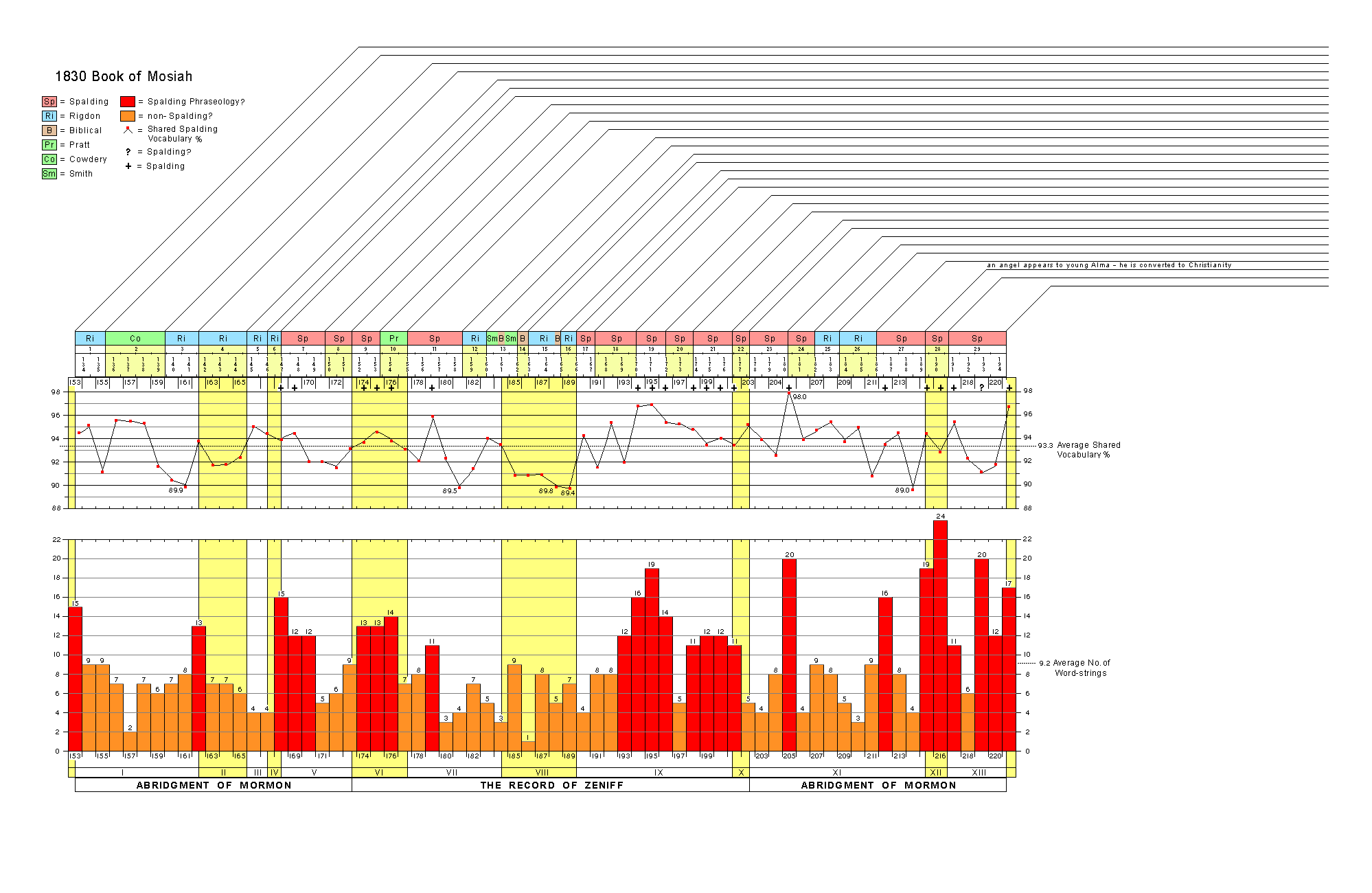
you’ll see my own color-coded chart for Mosiah authorship.
On the bottom are the 1830 BoM chapter divisions (also used by the RLDS)
some of these are clear breaks in the narrative and meant to serve as
chapter breaks. We see the same sort of narrative discontinuities in
Spalding’s Roman story — though in most cases he includes “Chapter #”
and a brief synopsis at these spots in his fictional writing.
The original “dictated” BoM manuscript had a page synopsis at the top
of many of its sheets. Now most of them are lost. I do not recall that
many of these summaries were copied over into the “printer’s manuscript.”
If not, then I do not know upon what basis the 1830 text was dicided
into its book chapters, upon publication.
>I think the only “natural” smaller-than-book breaks in the BofM are
>the typical pattern of the ancient author switching from one guardian
>to the next in mid-book.
In my Mosiah chart, we can see a clear example of what you mention,
where the Record of Zeniff is brought in (at Ch. VI) — If you look at
my red bar graph, at the bottom, you’ll see a spike in the distribution
of those bars just after Zeniff’s record begins. The red bars denote
the number of “significant word strings” shared by the BoM and Spalding.
If you look just above that spot on the graphic (still at the beginning
of Ch. VI) you’ll also see a spike in the line graph. That line denotes
the percentage of vocabulary overlap between Spalding and the BoM on those
pages — which is fairly high (above 92% shared vocabulary). Finally,
look at the top tier, where you’ll see a generalization of Jockers’
authorship attributions. He also shows a word-print spike for Spalding
in LDS Mosiah Ch. 9. All three charts “line up” at the start of Zeniff’s
record. It is a natural break in the narrative, and that “break” is one
of the Spalding “hot spots” in Mosiah.
Not every logical narrative break shows such a marked change in likely
authorship, of course. I point this one out as a good example, however.
Dale R. Broadhurst
Thanks.
Thanks, Dale. Two quick questions to see if I’m able to read the chart correctly.
I’m still having trouble understanding the definition of the blocks of data. What are the numbers in the 130’s and 150’s above the correlation coefficients?
The model appears to be a “best ball” approach of picking the highest correlation coefficient for any author for each block. There are an awful lot of degrees of freedom in such a model (determining how many and what it does to the significance of a correlation coefficient is a more complicated calculation than I have time to look into right now), but am I correct in my assumption that it is the best of the five possible correlations shown for every block?
>I’m still having trouble understanding the definition of the blocks of
>data. What are the numbers in the 130’s and 150’s above the correlation >coefficients?
At the top we have Jockers’ authorship attributions — below that are
the modern LDS Mosiah chapters and pages —
Below that is a line-graph of vocabulary overlap, ranging from 86-98%
At the top of that line graph are the 1830 page numbers.
Below that is a bar-graph of shared phraseology density, according to
the 1830 BoM page numbers. I’ve only counted what I feel to be the most
“significant” instances of common phraseology; and only mapped those
word-string occurrences across Mosiah, Alma and Ether, so far.
>The model appears to be a “best ball” approach of picking the highest
>correlation coefficient for any author for each block. There are an awful
>lot of degrees of freedom in such a model (determining how many and what
>it does to the significance of a correlation coefficient is a more
>complicated calculation than I have time to look into right now), but am I
>correct in my assumption that it is the best of the five possible
>correlations shown for every block?
The line graph is a simple count of shared vocabulary, expressed as %.
When I am finished, the bar graph at the bottom will also be expressed
in percentages (but percentages of a much, much less extensive shared
vocabulary, limited to 4-word phrases, 5-word phrases, and a very few,
but highly unusual 3-word phrases).
I’m still in the middle of finishing up the phraseology tabulations —
so they are expressed in raw number counts per page right now.
Dale R. Broadhurst
@Dale Broadhurst
Thanks for the clarification. I did get the raw count; mistook the percentages for correlation coefficients. Now I have to go borrow a hard copy of the LDS BofM. My CofChrist BofM has Mosiah running from pages 98-141.
>Thanks for the clarification. I did get the raw count; mistook the
>percentages for correlation coefficients. Now I have to go borrow a hard
>copy of the LDS BofM. My CofChrist BofM has Mosiah running from pages 98-141.
No need for that — I scanned the entire book — if you can put up
with all my underlinings:
http://solomonspalding.com/SRP/MEDIA/SRPpap16.htm
For example, you can look at the last page of the LDS and first page
of the LDS Alma, here:
[same URL plus SRP/MEDIA/P2/194.JPG
[same URL plus SRP/MEDIA/P3/195.JPG
The rather crudely done underlining on the hard copy text is
better executed here:
http://solomonspalding.com/SRP/MEDIA/BookMos1.htm#221a
At the top of my e-text for the 1830 ed. page 221 you’ll see the
notation of “word-strings=12” That is the same number set atop the
bar-graph for that page on the chart we looked at earlier.
Dale R. Broadhurst
>At the top of my e-text for the 1830 ed. page 221 you’ll see the

>notation of “word-strings=12″ That is the same number set atop the
>bar-graph for that page on the chart we looked at earlier.
Since you were interested in logical breaks in the narrative, the juncture
of Mosiah ending and Alma beginning offers an interesting example.
Here, on the 1830 BoM page 221 we see a high count of 12 significant
word-strings. Most of that overlap with Spalding can be found in the
Alma synopsis. If I had to make a bet, I would say that synopsis is
pure Solomon Spalding.
Dale R. Broadhurst